UNAAGI: Atom-Level Diffusion for Non-Canonical Amino Acid Substitutions
Published:
What amino acid could replace a residue while still fitting its local environment? With UNAAGI, we approach this question by generating the replacement side chain directly at the atom level. The model builds atom types, positions and bonds, so its proposals can include both canonical and non-canonical amino acids.
This post adapts our presentation at the Gubra meeting on 1 October 2026, with work by Han Tang, Alexander Tong and Wouter Boomsma. It walks through the method, examples of generated substitutions, and comparisons with published binding measurements. The original slide deck is also available.
Generating a side chain from noise
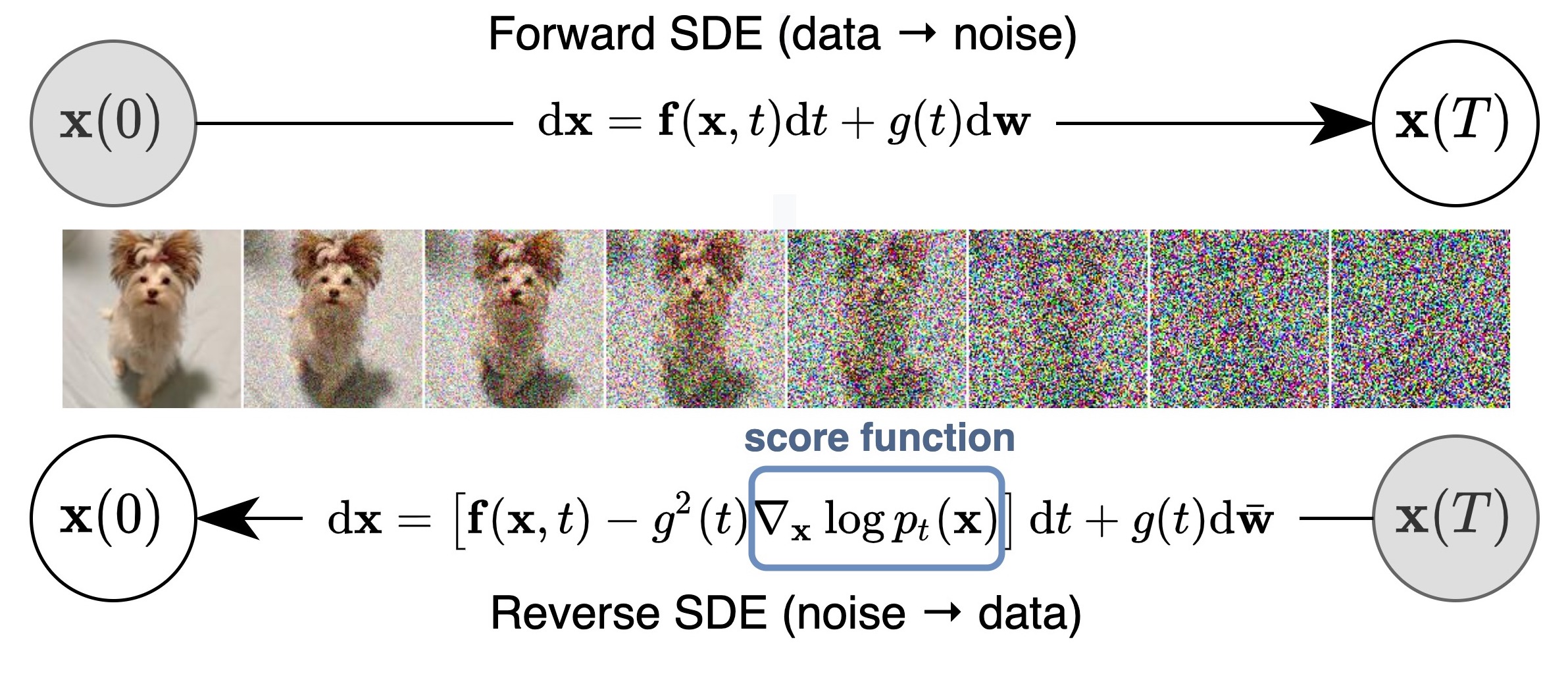
Diffusion models learn to generate structures through a pair of processes. During training, a forward process adds noise to examples. The model learns how to reverse that corruption, allowing it to start from noise and progressively construct a new sample.
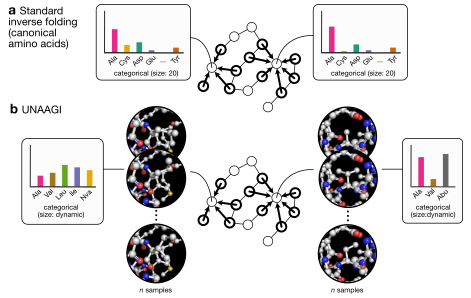
For UNAAGI, the object being generated is a single amino acid side chain in its structural context. We remove the side chain beyond Cα, hold the backbone and surrounding structure fixed, and ask the model to build a replacement using the surrounding atoms as context. Atom types, positions and bonds are generated together.
This representation lets the model propose side chains without selecting from a predefined amino acid list. In the sampling setup shown here, UNAAGI receives no peptide sequence, assay results or original residue identity. Its input is the local atomic environment that remains after the side chain is removed.
The animation below illustrates this process at position 7 of the CP2 macrocycle bound to KDM4A (PDB 5LY1), where the native residue is serine. In the first half, the side chain loses its structure and atom identities. In the second half, UNAAGI reconstructs serine from noise.
Testing substitutions in two peptides
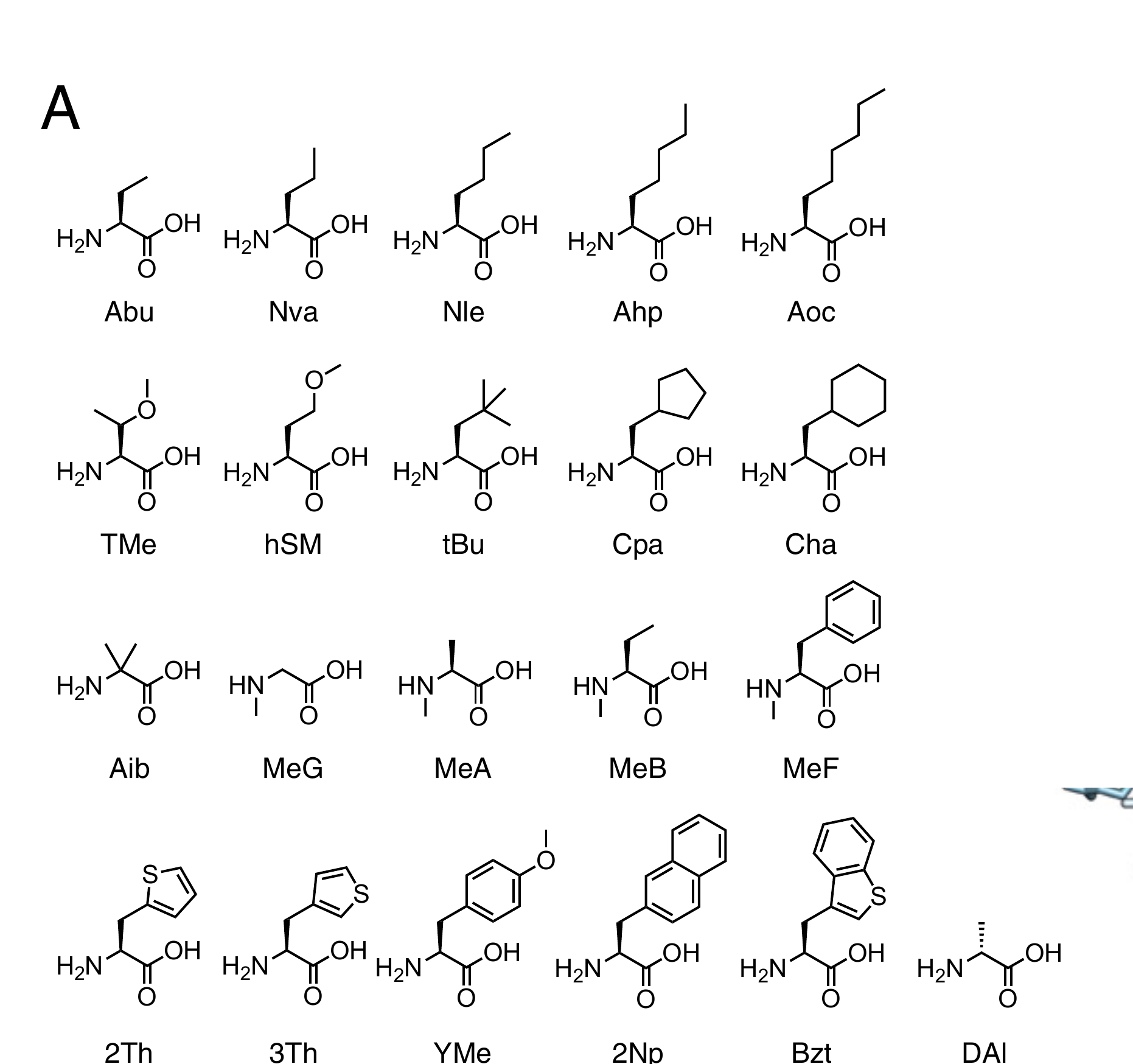
To examine whether the proposed substitutions are useful, we compare them with the nonproteinogenic deep mutational scanning study by Rogers, Passioura and Suga (2018). The study tested a set of 40 amino acids, including 21 non-canonical amino acids, by replacing one residue at a time in two peptides:
- PUMA, a helical peptide that binds MCL-1: 34 positions × 39 substitutions.
- CP2, a cyclic peptide that binds KDM4A: 12 positions × 39 substitutions.
The non-canonical set includes longer side chains, N-methylated residues and D-alanine, extending the substitutions beyond the usual canonical amino acid vocabulary.
The PUMA assay uses a reference peptide containing the M144A substitution. Ala144 in the examples below therefore refers to this benchmark reference.
The amino acids and CP2 complex used in the benchmark
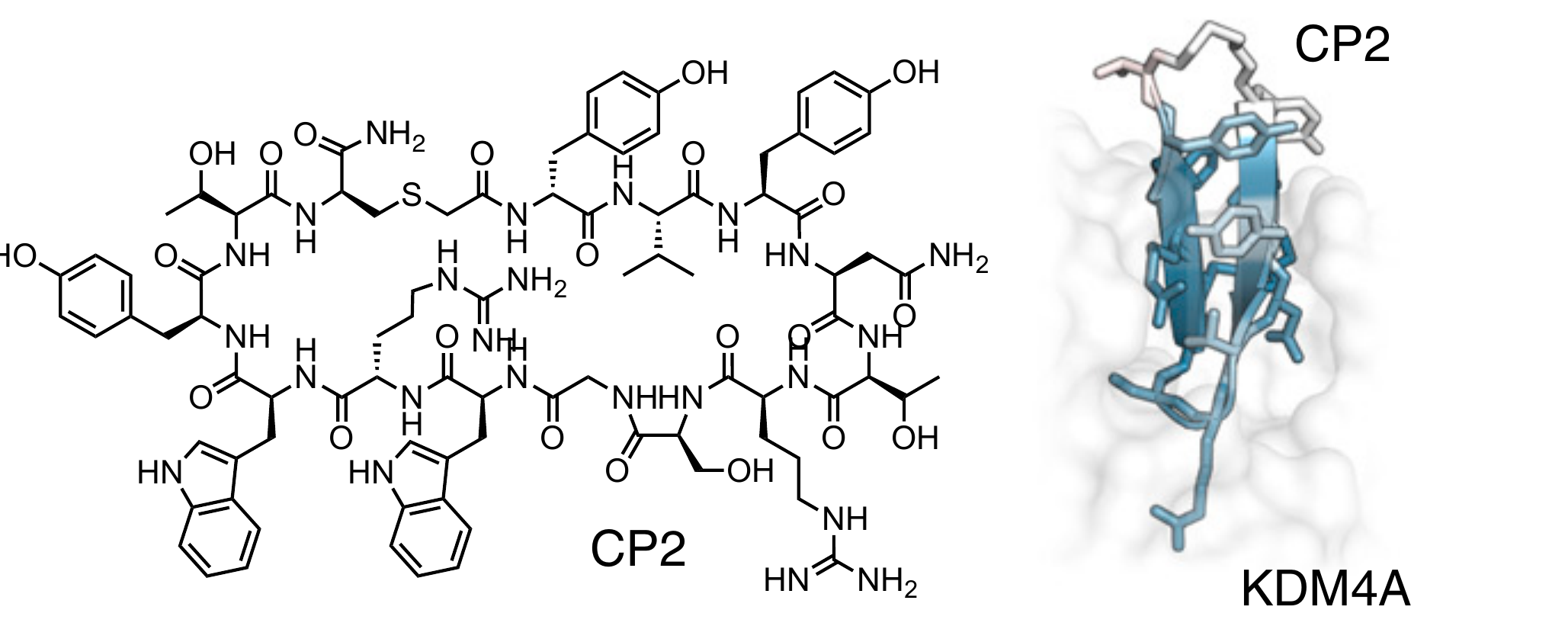
The experimental readout is the change in binding free energy relative to the original peptide, ΔΔG, in kcal/mol. Negative values mean stronger binding; positive values mean weaker binding. For this analysis, we call a substitution tolerated when ΔΔG < 0.5 kcal/mol, allowing a small loss in binding.
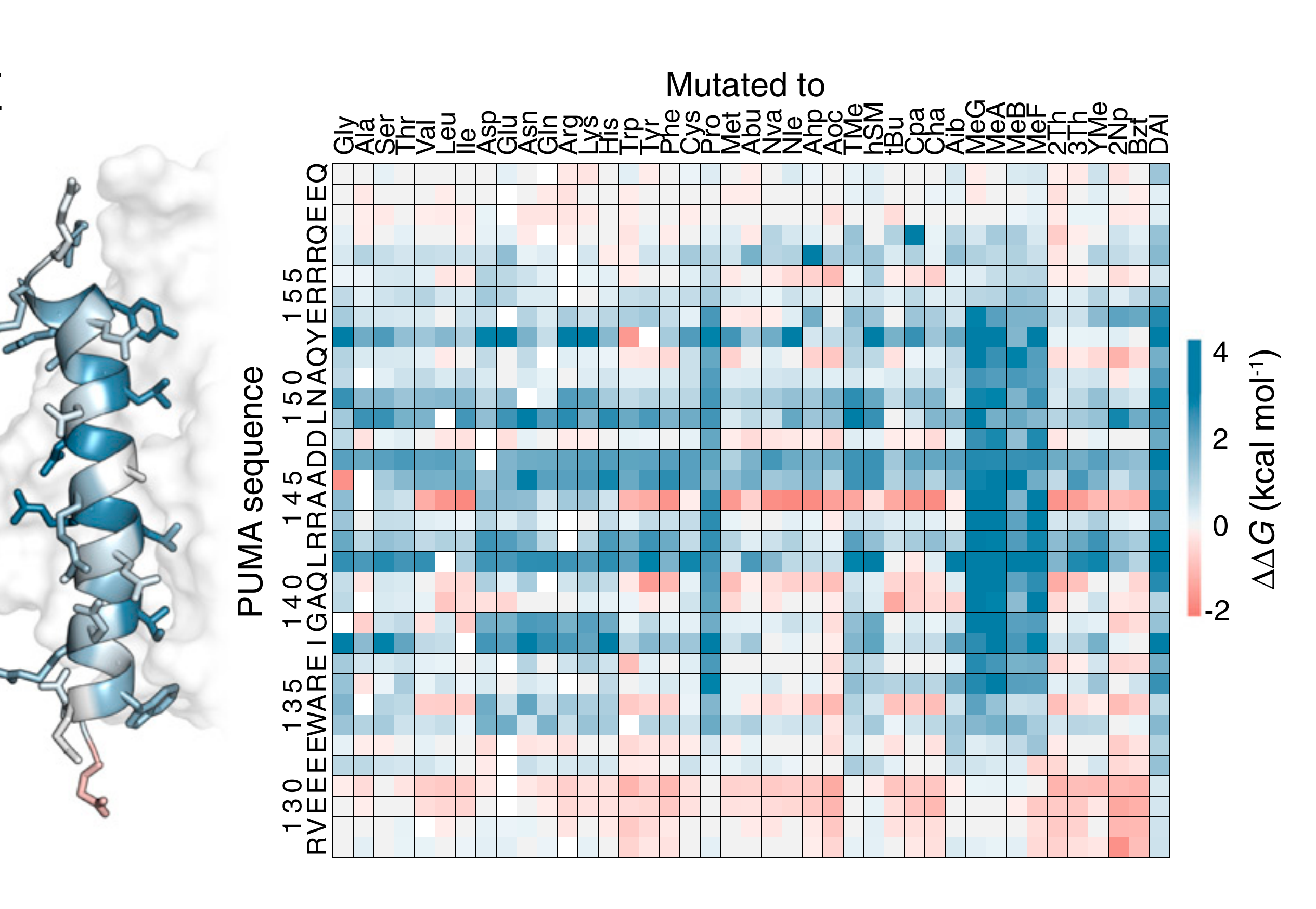
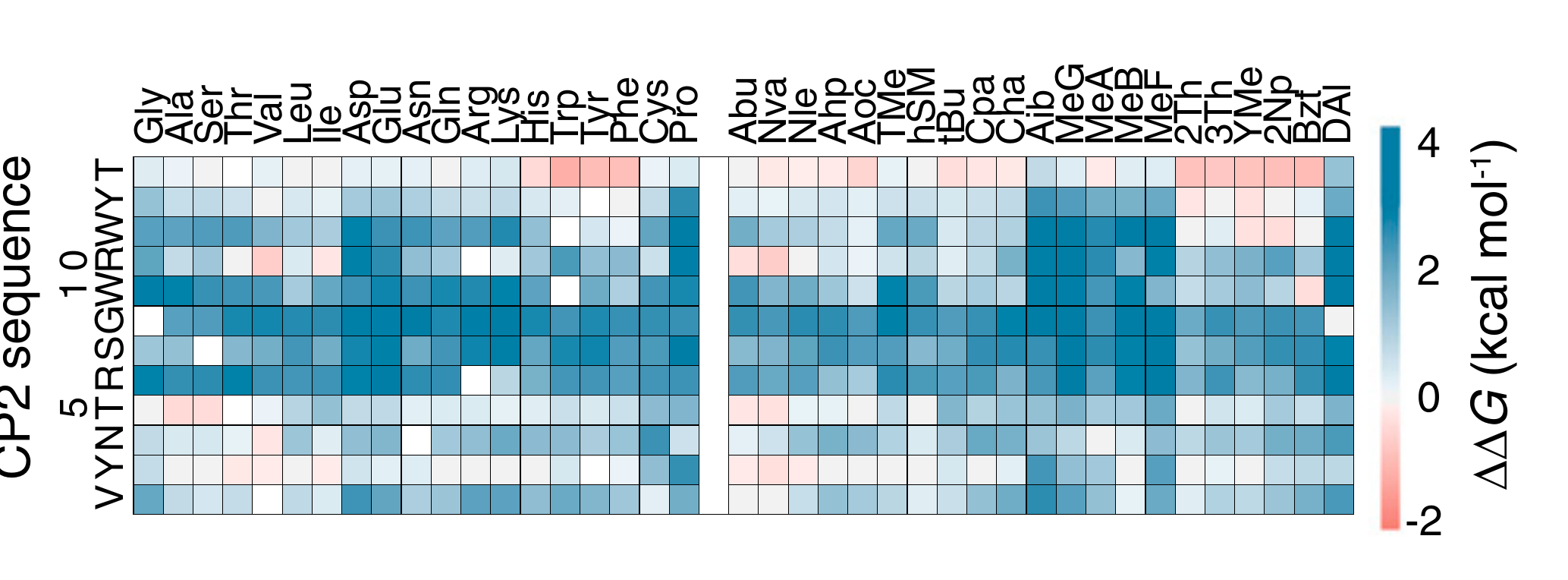
How to read the examples: UNAAGI generates substitutions without access to these assay results. The ΔΔG values below come from the published experimental benchmark. They are measurements for the corresponding substitutions, rather than binding energies predicted by the diffusion model or new experiments on these generated structures.
What the model generates at individual sites
We can first look at the structural context of one site. The following animation zooms into Leu141 in PUMA, shown in green, within the MCL-1 complex. Removing the side chain beyond Cα leaves the local environment from which UNAAGI generates a replacement.
A hydrophobic site: PUMA Ala144
At Ala144, UNAAGI samples several residues whose substitutions improve measured binding. These include the non-canonical residue norleucine, alongside isoleucine, phenylalanine, leucine and tryptophan. In this example, direct atom generation reaches a non-canonical alternative with a binding effect similar to isoleucine.
More alternatives at CP2 Thr13 and PUMA Ala139
Other sites also admit several generated alternatives with favourable measured effects. At CP2 Thr13, examples include phenylalanine (−0.96), histidine (−0.47) and non-canonical norvaline (−0.20). At PUMA Ala139, the model produces leucine (−0.80), tyrosine (−0.20) and non-canonical norleucine (−0.04). All values are ΔΔG in kcal/mol.
Watch the CP2 Thr13 and PUMA Ala139 examples
Tolerated substitutions at restrictive sites
The examples also include sites where fewer substitutions are tolerated. UNAAGI generates glycine at PUMA Ala145, and tert-butylalanine at Leu148 and Leu141. The Leu141 substitution has a slightly positive ΔΔG, so it is tolerated under our threshold but does not improve measured binding.
| PUMA site | Generated substitution | Measured ΔΔG (kcal/mol) |
|---|---|---|
| Ala145 | Glycine | −1.71 |
| Leu148 | tert-Butylalanine | −0.04 |
| Leu141 | tert-Butylalanine | +0.02 |
Agreement with experimental rankings
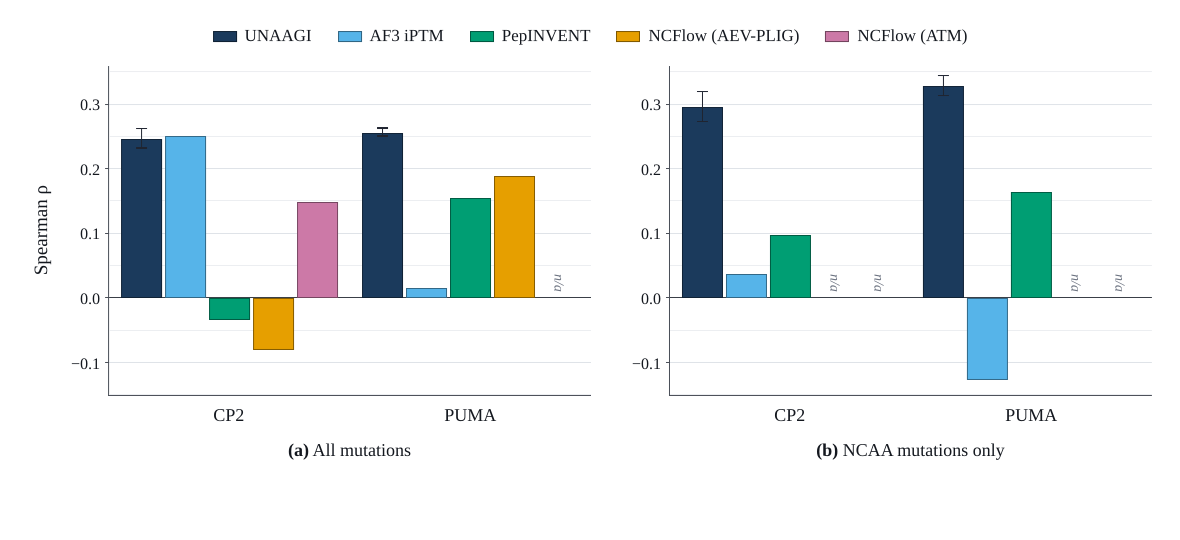
Individual examples show what generation looks like, but the broader comparison asks whether model rankings agree with the measured effects on binding. In the comparison presented here, UNAAGI has the highest correlation for non-canonical substitutions in both peptides among the displayed baselines. Across all substitutions, it leads on PUMA and performs similarly to the AlphaFold 3 iPTM score on CP2.
We also evaluate canonical substitutions across 25 assays from ProteinGym as a complementary check. This comparison addresses conventional amino acid substitutions across a broader set of assays; the 25 assays are a subset of ProteinGym.
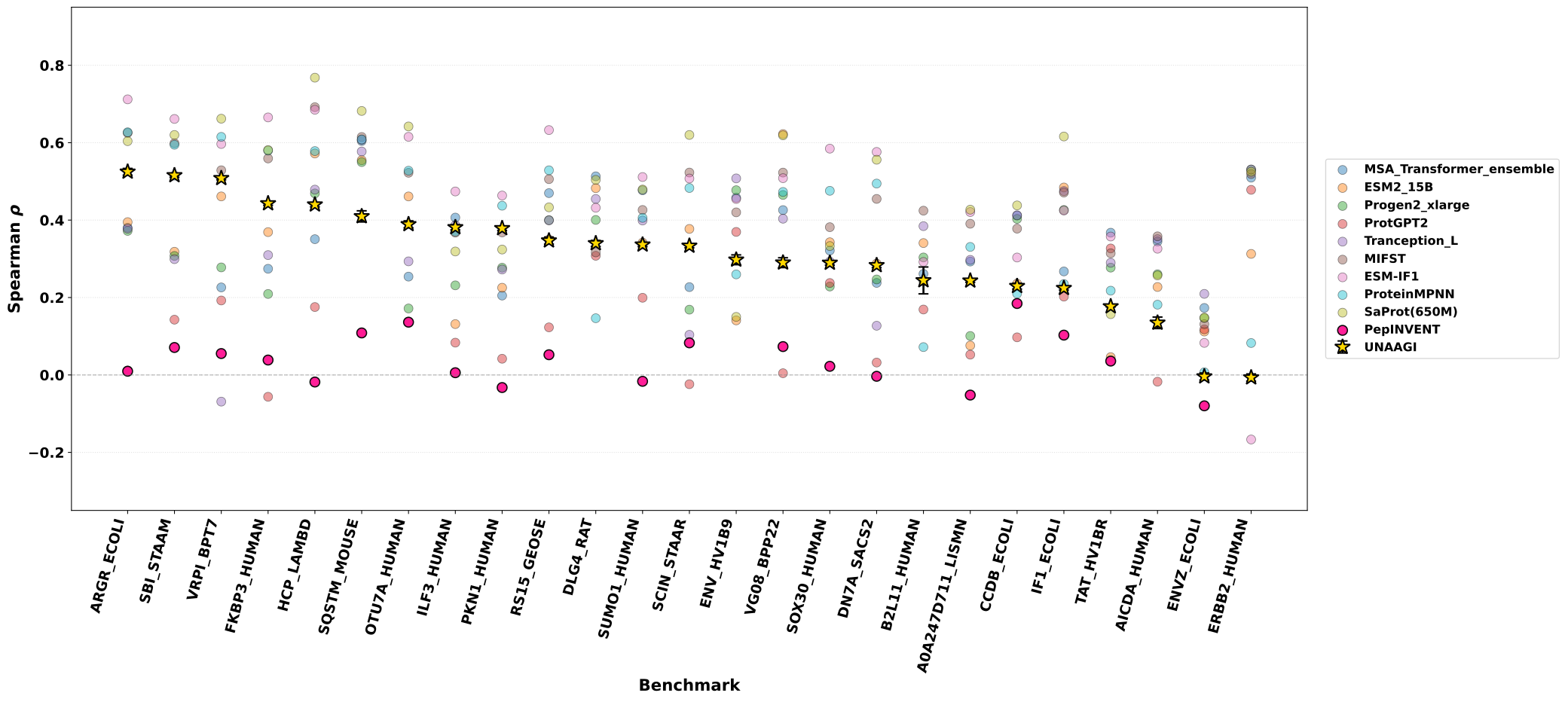
These comparisons address agreement with experimental substitution effects in the evaluated settings. The examples remain local side chain substitutions with a fixed backbone and environment; extending the method to broader design tasks requires further evaluation.
Scoring chosen residues and learning from assays
Two directions are in progress.
Conditional diffusion for scoring a chosen amino acid. We are developing a model that takes both the local atomic environment and a target residue identity, and estimates how well that chosen amino acid fits. This would support scoring specific canonical and non-canonical substitutions, alongside generating candidate side chains.
Preference optimisation using experimental results. We plan to use assay measurements to favour substitutions with better binding: generate candidates, measure them, update the model, and use the new data to guide the next round of generation. This is a planned extension of the current work.
The results so far suggest that local atomic context can guide proposals beyond the canonical amino acid vocabulary. The next step is to make those proposals easier to score for a chosen residue and to improve them using experimental feedback.
References and figure credits
- Rogers, J. M., Passioura, T., & Suga, H. (2018). Nonproteinogenic deep mutational scanning of linear and cyclic peptides. Proceedings of the National Academy of Sciences, 115(43), 10959–10964. Benchmark panels A, E, F and G are reproduced as supplied in the deck, without modification. © 2018 the authors; published by PNAS under CC BY-NC-ND 4.0.
- Notin, P., et al. (2023). ProteinGym: Large-Scale Benchmarks for Protein Fitness Prediction and Design. Advances in Neural Information Processing Systems, 36, 64331–64379.
The UNAAGI schematics, generated structure animations and result plots accompany the original presentation by Han Tang, Alexander Tong and Wouter Boomsma, presented on 1 October 2026.
Leave a Comment