UNAAGI: Atom-Level Diffusion for Generating Non-Canonical Amino Acid Substitutions
Han Tang, Alexander Tong, Wouter Boomsma
01.10.2026 · Gubra Meeting
Background
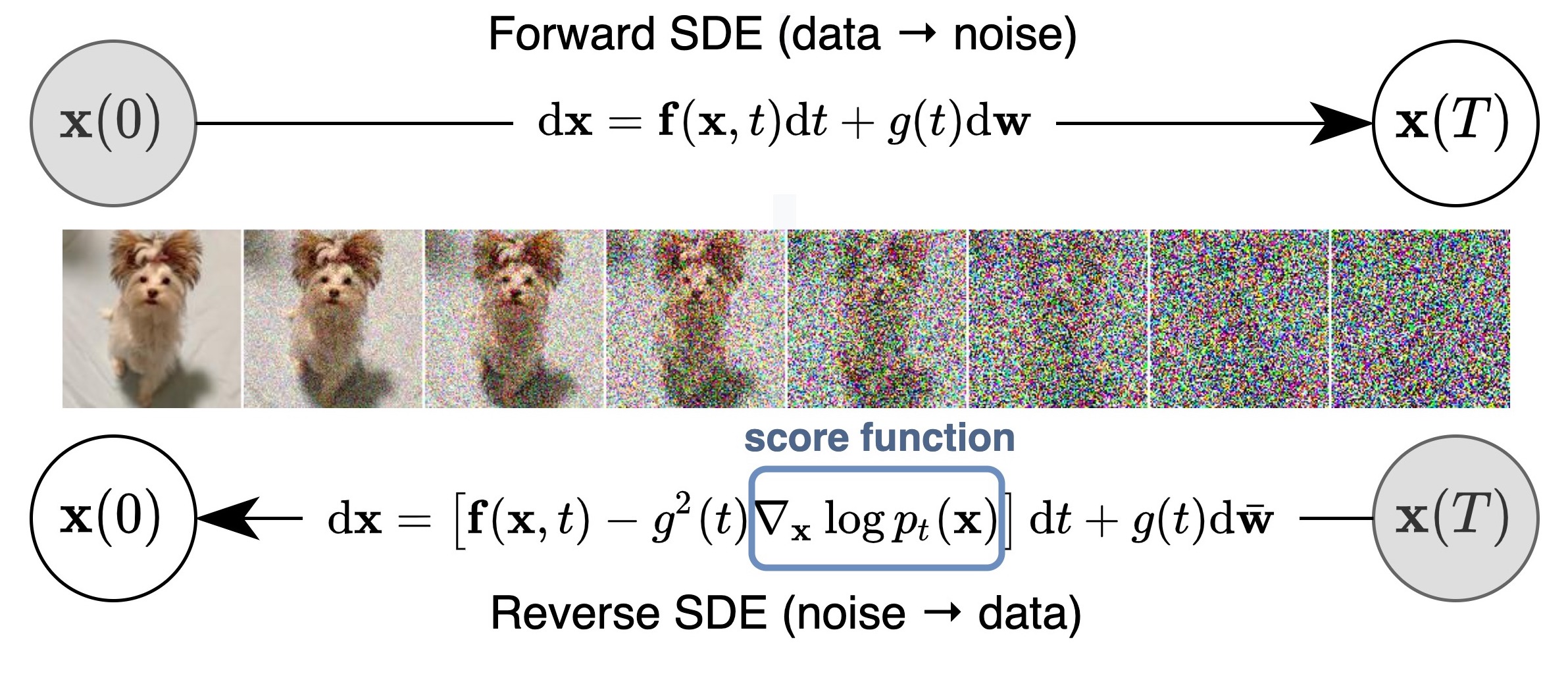
Diffusion learns to build structures from noise
Diffusion models learn to generate structures by first adding noise to examples,
then learning to reconstruct them.
Background
Method
UNAAGI illustration in motion
Position 7 of the CP2 macrocycle bound to KDM4A (PDB 5LY1); native residue
serine. Backbone and pocket are held fixed throughout.
Forward. We play the animation backwards to show the side chain breaking down
into noise, losing its structure and atom identities.
Reverse. Starting from noise, the model builds a side chain by generating atom
types, positions and bonds. In this example, it reconstructs serine.
Method
Method
Generating side chains to fit their local environment
The backbone and surrounding structure stay fixed while UNAAGI removes the side chain
beyond Cα and rebuilds it from noise.
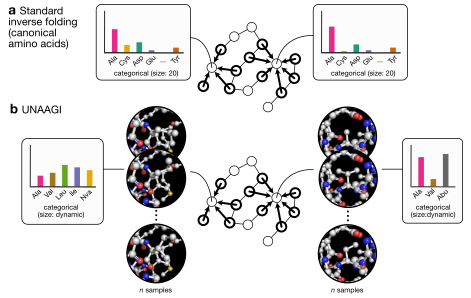
The model generates atom types, positions and bonds together. Because it works
directly with atoms, it can build both canonical and non-canonical side chains
without choosing from a predefined list of amino acids.
Method
Benchmark
Testing amino acid substitutions in two peptides
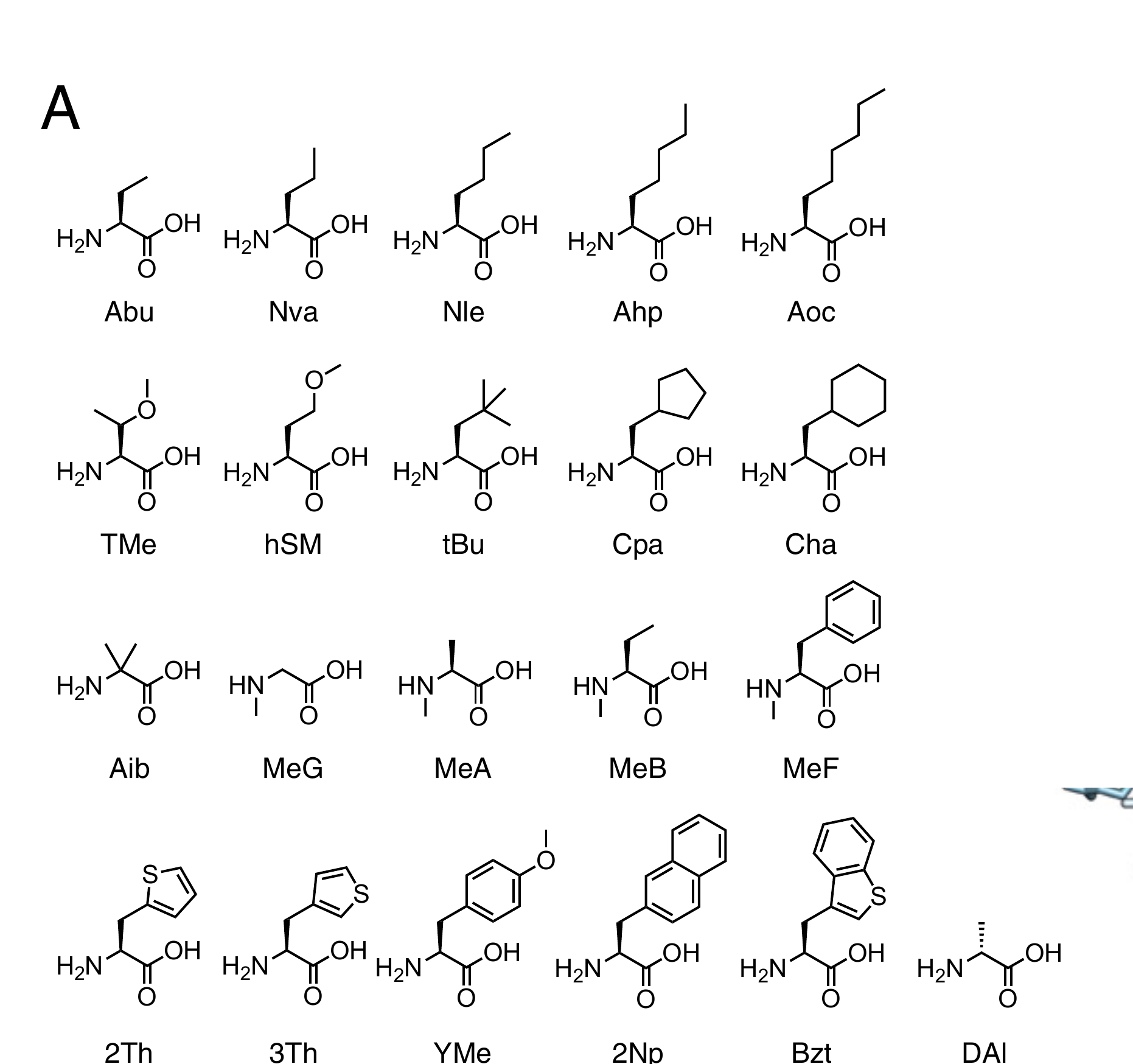
The 21 non-canonical amino acids tested include longer side chains,
N-methylated residues and D-alanine.
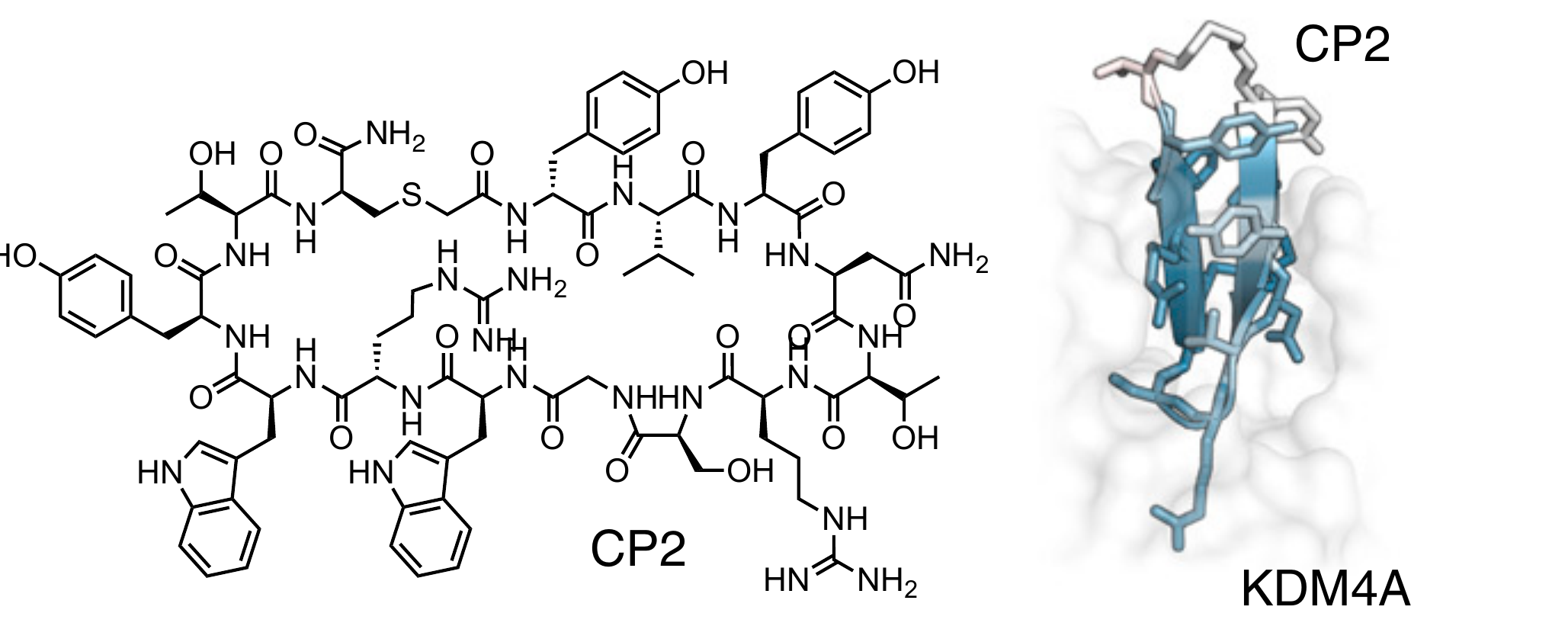
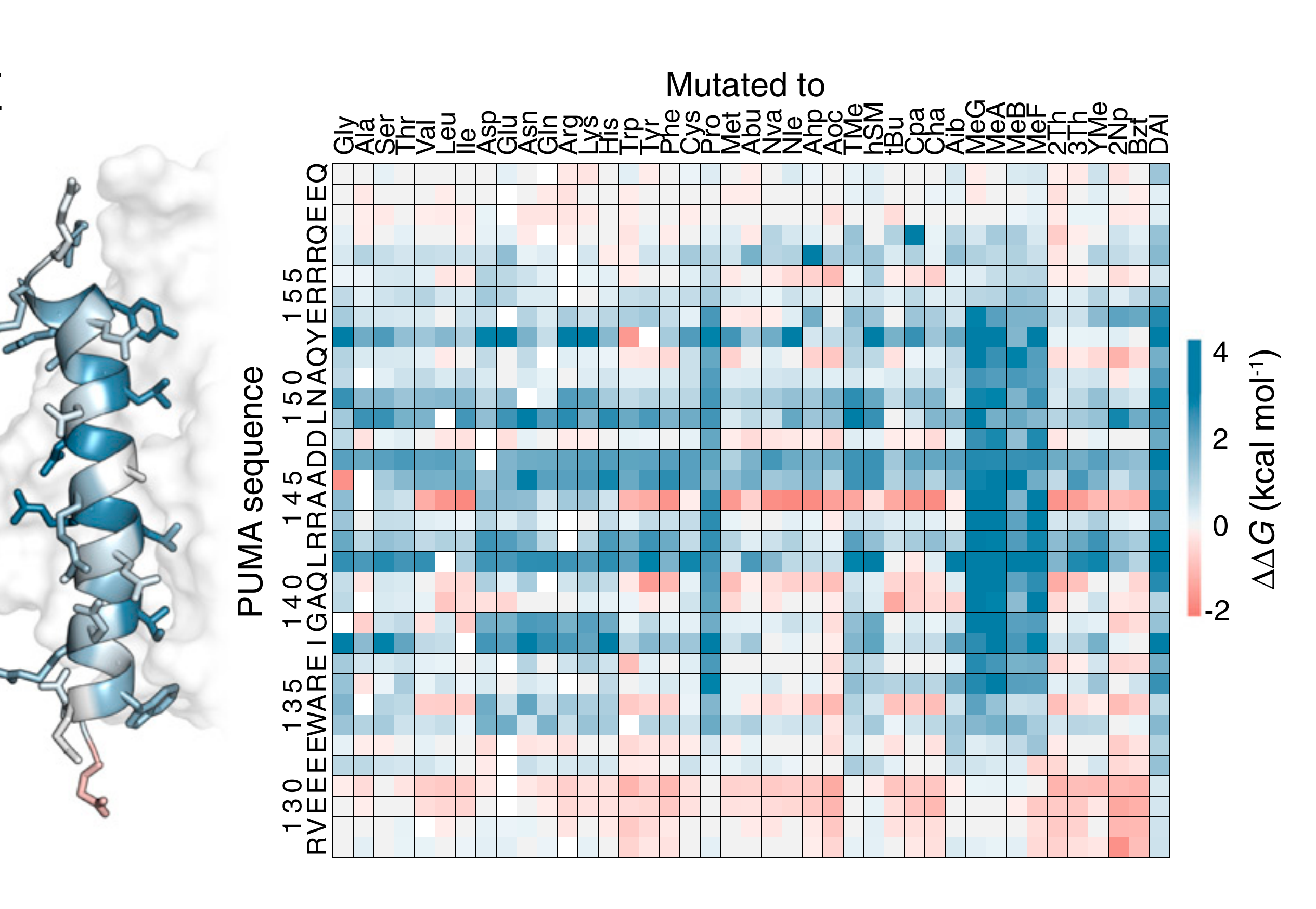
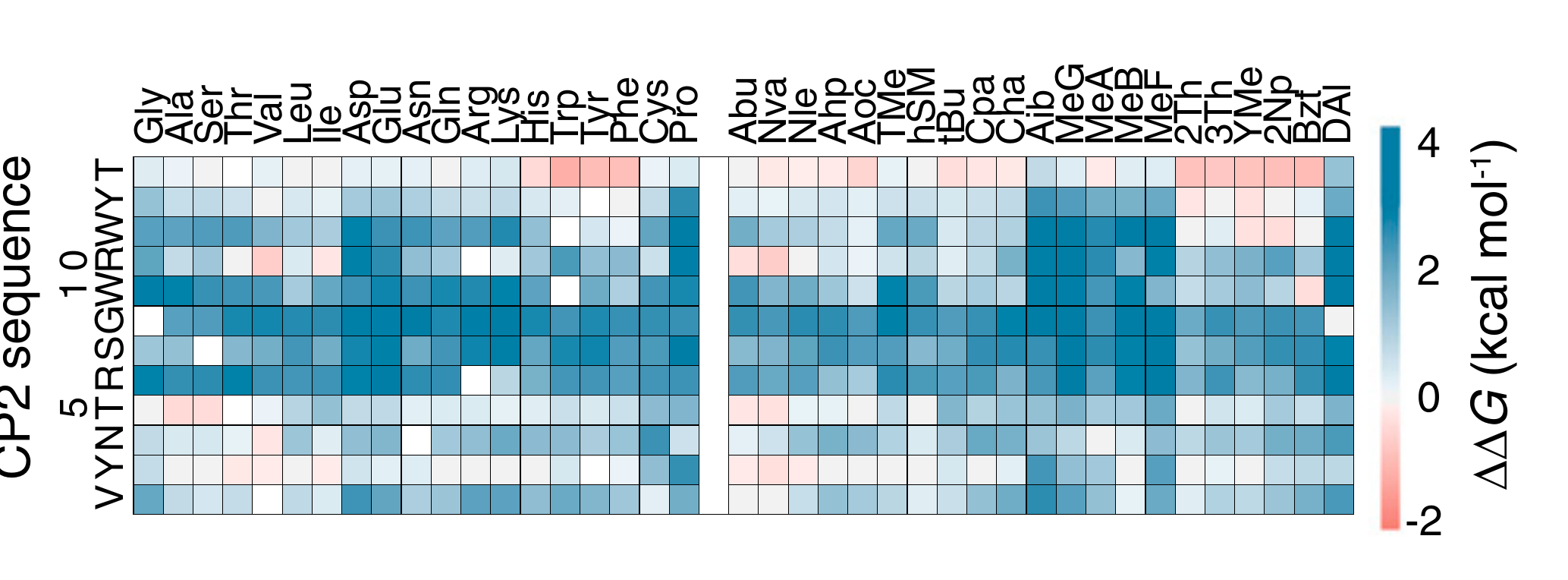
CP2 is a cyclic peptide that binds KDM4A. PUMA is a helical peptide
that binds MCL-1.
The study tested a set of 40 amino acids,
replacing one residue at a time and measuring the change in binding (ΔΔG).
Negative values mean stronger binding than the original peptide.
Panels A and F from Rogers JM, Passioura T, Suga H. “Nonproteinogenic deep
mutational scanning of linear and cyclic peptides.” PNAS 2018;115(43):10959–10964.
Open access, CC BY-NC-ND.
Benchmark
Benchmark
How substitutions affect binding
PUMA binding to MCL-1: 34 positions × 39 substitutions.
CP2 binding to KDM4A: 12 positions × 39 substitutions.
Red means stronger binding. Blue means weaker binding.
Values show the change from the original peptide (ΔΔG in kcal/mol).
We count substitutions with ΔΔG < 0.5 kcal/mol as
tolerated, allowing a small loss in binding. We test whether UNAAGI proposes
these substitutions without access to the assay results.
Panels E and G, same source.
Benchmark
Sampling
Take one side chain out, and ask the model to rebuild it
PUMA bound to MCL-1. The animation zooms in on Leu141, shown in green.
We remove the side chain beyond Cα, keeping the backbone and surrounding
structure fixed.
UNAAGI uses the surrounding atoms to generate a replacement side chain. It receives
no peptide sequence, assay results or original residue identity.
Sampling
Sampling · PUMA 144
At a hydrophobic site, UNAAGI samples amino acids that improve binding, including non-canonical residues
Glu153 tolerates 11 substitutions and the model produced 9 of
them, missing only 2-aminooctanoic acid and tert-butylalanine — both of
which it does build elsewhere.
Tyr152the site→ tryptophan−1.57
Tyr152 tolerates 7, and the model produced exactly one —
tryptophan, which happens to be the best of the seven.
The gap is a specific one. Five of the six it misses at Tyr152 are bulky
aromatic non-canonicals — benzothienyl-alanine, 2- and 3-thienyl-alanine,
O-methyl-tyrosine and 2-naphthyl-alanine; the sixth is 2-aminoheptanoic acid, which the
assay only just tolerates (+0.47). The unconditional prior rarely proposes the aromatic class
anywhere. It is the clearest target for the conditional model, and the reason we are building one.
Restrictive positions
Validity
Are the molecules it draws actually right?
51 / 53correct bond orders
45 / 53every bond within 10%
Across every residue shown in this deck we checked the generated
molecule rather than the label: element-by-element bond lengths against ideal values, ring
planarity, and non-bonded clashes — then the bond orders, which the
graph-isomorphism labeller ignores.
Aromatic rings come out planar and correctly conjugated; aliphatic chains come out
saturated; amide and carboxylate groups carry their double bonds in the right place.
Check
Result
Side-chain bond orders
51 / 53
Every bond within 10% of ideal
45 / 53
No non-bonded contact < 2.45 Å
51 / 53
Aromatic rings planar and conjugated
13 / 13
Saturated rings puckered
0 / 2
The one real failure is worth naming.
Cyclopentyl-alanine came out with two double bonds in its five-membered ring — a flat
cyclopentadiene rather than a puckered cyclopentane. The labeller matched it anyway,
because it compares skeletons and not bond orders. Both draws of it, at two separate
positions, failed the same way. Saturated rings are a known weak point and we report it
as one.
Validity
Result
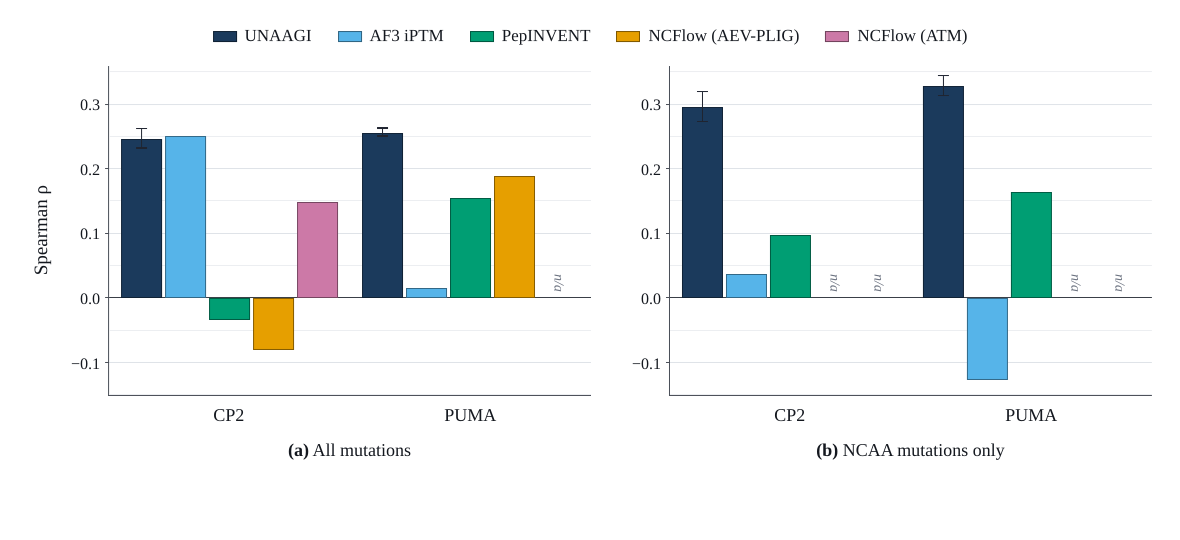
UNAAGI has the highest correlation for non-canonical substitutions
Higher bars mean closer agreement between each model’s ranking and the measured
effects on binding.
UNAAGI leads for non-canonical substitutions in both peptides. Across all
substitutions, it leads on PUMA and performs similarly to AF3 iPTM on CP2.
Result
Sanity check
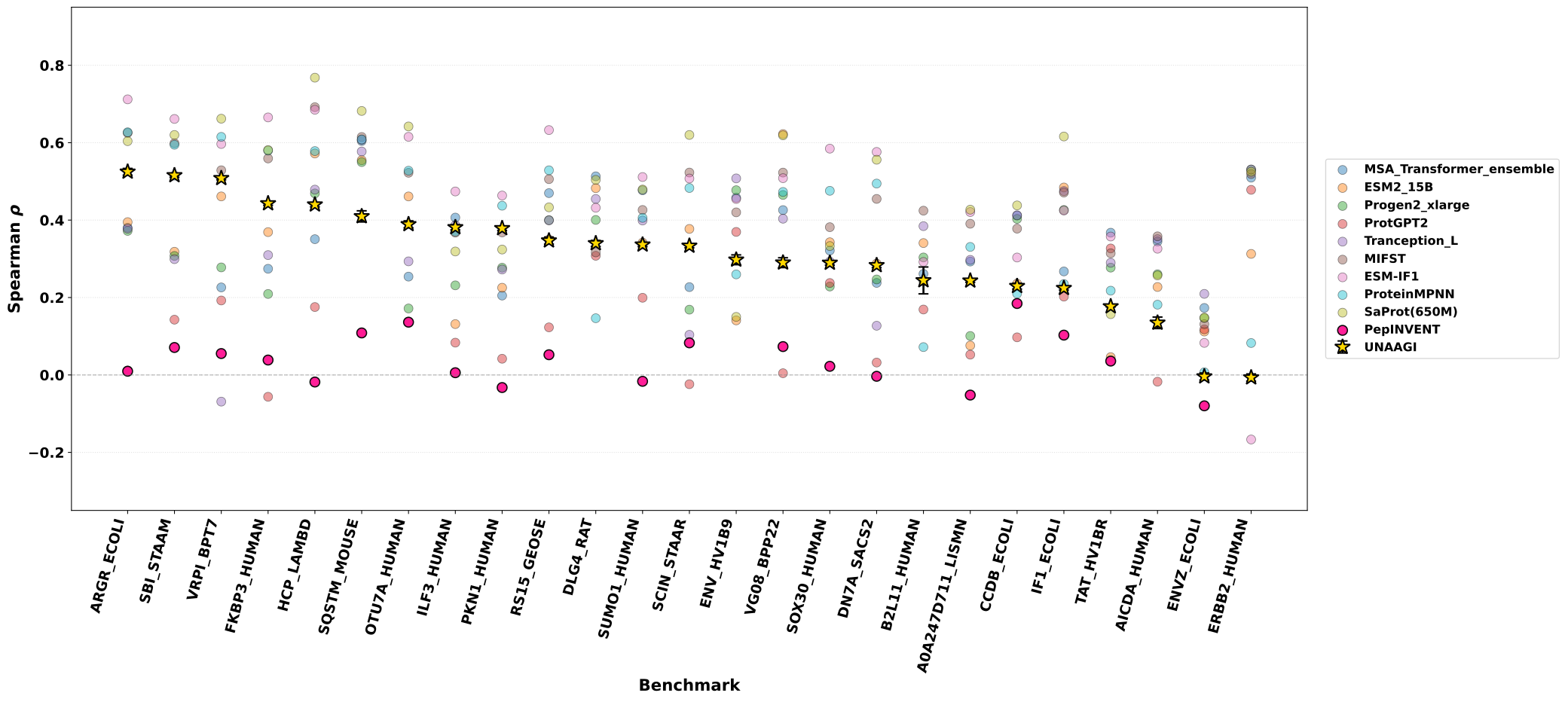
Benchmarking canonical substitutions across 25 ProteinGym assays
Sanity check · ProteinGym
In progress
Next steps: scoring specific amino acids and learning from assay data
1 · Conditional diffusion
Scoring a chosen amino acid
We are developing a model that estimates how well a chosen amino acid fits its local
atomic environment. This will support scoring both canonical and non-canonical substitutions.
2 · Preference optimisation
Learning from experimental results
We plan to use assay results to favour substitutions with better measured binding.
New data will guide model updates and the next round of candidate generation.